
Basking Shark Facts for Kids
Imagine a sea creature as long as a school bus swimming through the ocean with its mouth wide open. It might look terrifying at first, but this massive fish is completely harmless to humans! Welcome to the world of the basking shark, one of the most fascinating gentle giants of the ocean.
In this article, you will explore amazing basking shark facts, including where these giant fish live, what they eat, how their huge mouths work, and why they spend so much time near the sunny surface of the sea.
Why Learning About Basking Sharks Matters
- Ocean Guardians: Understanding basking sharks helps scientists protect ocean food chains and marine habitats.
- Amazing Adaptations: They show how impressive animal adaptations allow huge creatures to survive on tiny food.
- Shark Diversity: Learning about filter feeders helps us see that not all sea creatures hunt with sharp teeth like typical predators.
What Is a Basking Shark?
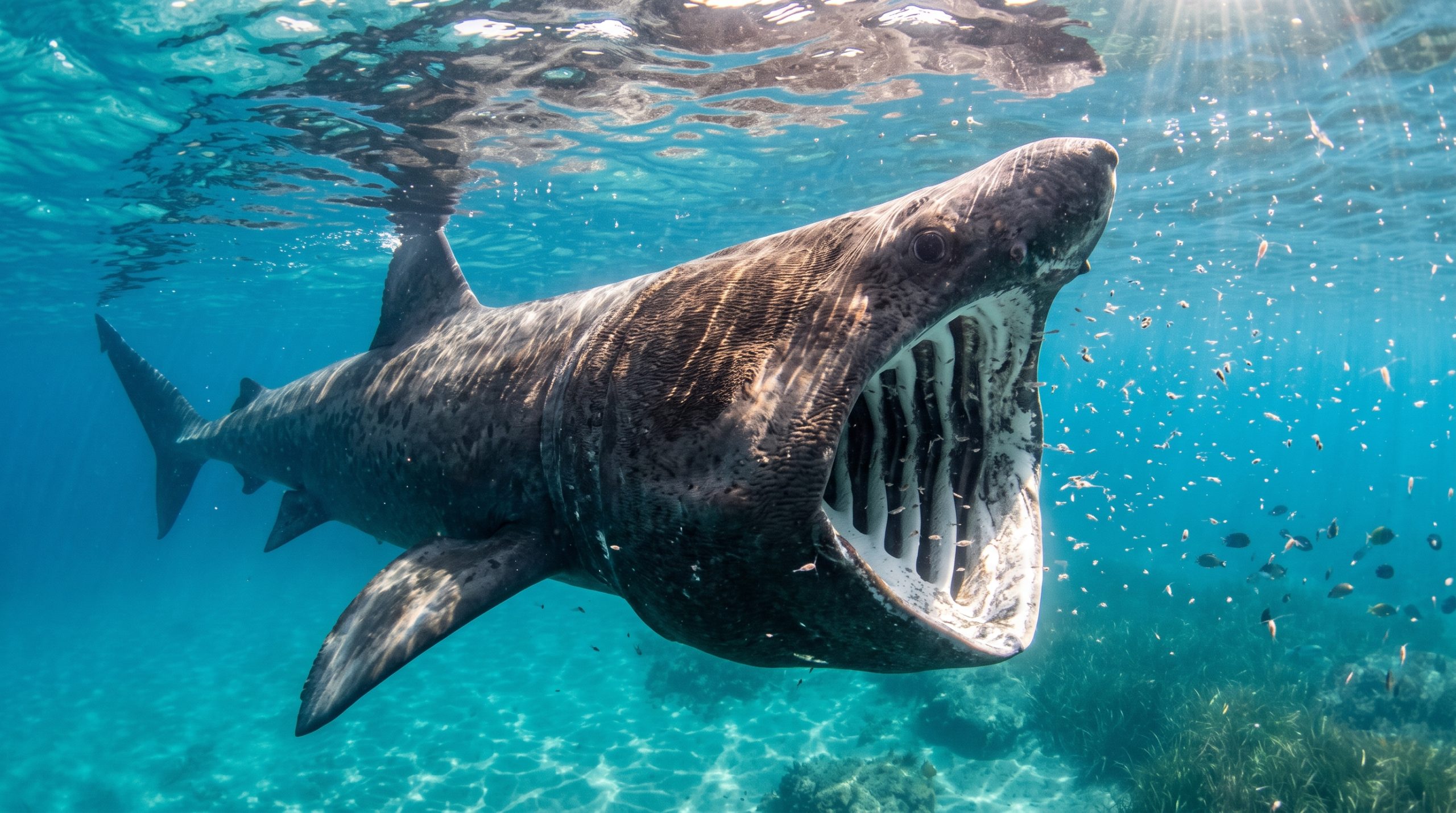
A basking shark (Cetorhinus maximus) is a huge, slow-moving fish that is the second-largest living fish species on Earth, right after the whale shark.
Despite their colossal size, basking sharks are gentle filter feeders that do not hunt large prey. Instead of chasing seals or smaller fish, they glide through coastal waters with their giant mouths open to swallow tiny floating sea organisms called plankton. You can think of a basking shark as the ocean's giant underwater vacuum cleaner, calmly straining thousands of gallons of seawater every single hour.
The 4 Main Body Features of a Basking Shark
To understand how these gentle giants survive in cold ocean waters, let's look at their primary physical characteristics:
- Massive Mouth: Expands over three feet wide to scoop up plankton-filled water.
- Enormous Gill Slits: Circle almost around the entire head to filter out food.
- Gill Rakers: Bristle-like structures inside the gills that trap food particles.
- Crescent Tail Fin: Strong, powerful tail that helps propel their heavy bodies through the water.
Quick-Facts Overview
| Feature | Basking Shark Details |
|---|---|
| Scientific Name | Cetorhinus maximus |
| Animal Class | Chondrichthyes (Cartilaginous Fish) |
| Typical Length | About 20 to 26 feet (6 to 8 meters) |
| Maximum Size | Up to about 40 feet long and about 7 tons |
| Ocean Habitat | Temperate and cool coastal waters worldwide |
| Primary Diet | Zooplankton (microscopic animals) |
| Estimated Lifespan | About 50 years |
Giant Mouth and Jaw
The most famous feature of the basking shark is its enormous mouth, which can open up to 3 feet (1 meter) wide.
- Mouth Width: Can measure over 3 feet across when fully expanded.
- Tooth Size: Hundreds of tiny, hooked teeth that are only about a quarter-inch long.
- Function: Serves as a wide scoop for gathering plankton-rich seawater.
Even though they belong to the shark family alongside species described in our guide to different types of sharks, basking sharks do not use their teeth for biting or chewing. Their tiny teeth are mostly useless for hunting, making them completely peaceful ocean dwellers.
Now, let's explore how their gills play a vital role in breathing and eating at the same time.
Extended Gill Slits
Unlike the small gill slits seen on a tiger shark, a basking shark has massive gill slits that almost meet around its neck.
- Structure: Five huge gill slits wrapping around the sides and underside of the head.
- Water Flow: Allows huge volumes of water to pass smoothly out of the body.
- Dual Purpose: Supplies oxygen to the blood while separating food from water.
These large gill slits act like high-speed water drains, allowing seawater to exit quickly while holding back nutrition. Next, we look at the secret tools inside those gills.
Specialized Gill Rakers
Inside the gill slits are dark, comb-like structures called gill rakers that act as natural strainers.
- Appearance: Long, bristly projections attached to the arch of each gill.
- Composition: Made of modified dermal denticles (scale-like structures).
- Shedding Cycle: Basking sharks shed and rebuild their gill rakers every winter.
As water passes through the gills, these rakers catch thousands of tiny microscopic animals. Without these special strainers, the shark could not collect enough food to survive. Next, let's examine how their powerful fins move their huge bodies.
Conspicuous Fins and Large Tail
A basking shark features a prominent triangular dorsal fin on its back and a strong, crescent-shaped tail.
- Dorsal Fin: Stands up to 3 feet tall, often sticking out above the water line.
- Tail Shape: Equal-sized upper and lower tail lobes, similar to great white sharks.
- Swimming Speed: Typically cruises slowly at about 2 to 3 miles per hour.
Because their dorsal fins peak above the ocean surface, boats often spot them "basking" in the sun, which is how they got their popular name! Next, let's look at the exact mechanism they use to eat.
How Filter Feeding Works in Basking Sharks
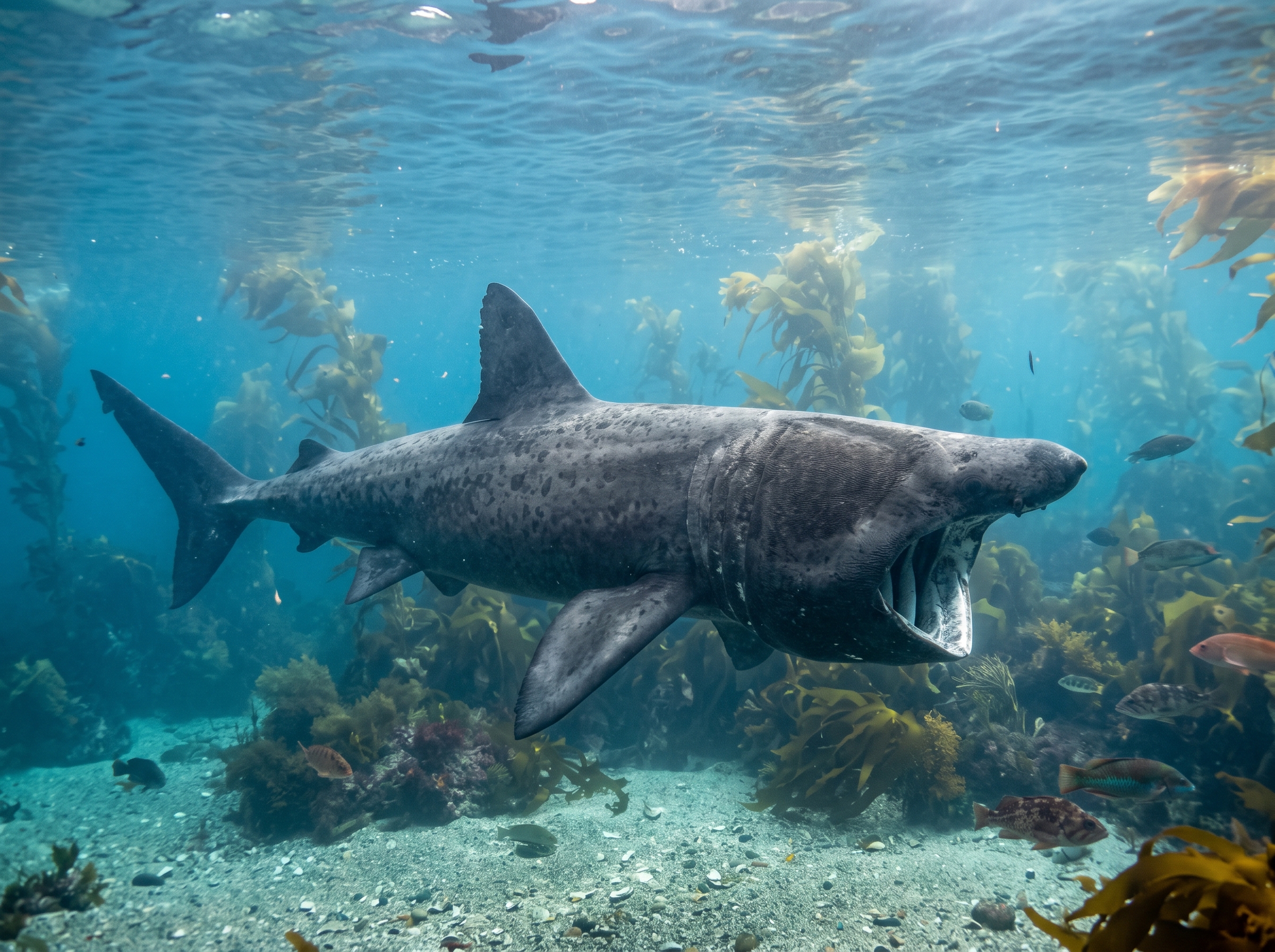
Filter feeding is a clever process that allows large ocean animals to eat tiny organisms without catching individual prey. Here is how a basking shark feeds in 4 simple steps:
- Surface Cruising: The shark swims near the ocean surface where sunlight allows plankton blooms to grow.
- Mouth Expansion: It opens its jaws wide while swimming forward at a steady pace.
- Water Straining: Water flows into the mouth and pushes out through the massive gill slits.
- Plankton Trapping: The comb-like gill rakers trap tiny zooplankton while clean water flows back into the sea.
Basking Shark Vocabulary
Master these important marine biology terms to sound like an expert ocean researcher!
| Term | Simple Meaning |
|---|---|
| Basking | Resting or swimming slowly near the warm surface of the water. |
| Filter Feeder | An animal that feeds by straining food particles from water. |
| Zooplankton | Tiny floating animals and organisms that drift in ocean currents. |
| Gill Rakers | Comb-like bristles inside gills that trap small food particles. |
| Dorsal Fin | The main fin located on the back of a fish or shark. |
| Cartilage | Flexible structural tissue that forms a shark's skeleton instead of bone. |
| Plankton Bloom | A huge concentration of microscopic organisms floating together. |
| Temperate Waters | Mild ocean regions that are neither freezing cold nor tropical hot. |
Summary: Basking Sharks at a Glance
Here is a quick recap of how basking sharks survive in ocean ecosystems:
- Size & Diet: Second-largest fish in the world; eats tiny zooplankton.
- Feeding Style: Passive ram filter feeding with open jaws.
- Unique Feature: Sheds and regrows comb-like gill rakers annually.
- Key Takeaway: Massive size does not mean dangerous behavior; basking sharks are harmless ocean giants that maintain marine balance.
Species Comparison Table
| Feature | Basking Shark | Whale Shark | Angel Shark |
|---|---|---|---|
| Size Rank | 2nd Largest Fish | 1st Largest Fish | Much Smaller |
| Feeding Method | Ram Filter Feeding | Suction Filter Feeding | Ambush Predator |
| Body Shape | Torpedo Shape | Broad & Flat Head | Flat, Ray-like |
| Primary Food | Zooplankton | Plankton & Small Fish | Fish & Crustaceans |
| Learn More | Current Guide | Whale Shark Facts | Angel Shark Facts |
Amazing Basking Shark Facts
- FACT 1: A basking shark's oily liver can make up about one-quarter of its body weight—like packing a giant life jacket inside so this heavy fish floats with less effort!
- FACT 2: Folk names for basking sharks have included bone shark, elephant shark, and big mouth shark because of their huge heads and gaping jaws.
- FACT 3: Despite their slow cruise speed, basking sharks can sometimes breach—leaping partly or fully out of the water, like a school bus briefly hopping above the waves.
- FACT 4: While feeding, a basking shark may filter thousands of gallons of seawater each hour through its gill rakers—picture a living water filter humming along near the sunny surface.
- FACT 5: Basking sharks do not have bony skeletons; like all sharks, their bodies are supported by flexible cartilage—the same bendy stuff in the tip of your nose, just shark-sized!
- FACT 6: In winter, when plankton snacks get scarce, basking sharks shed their gill rakers and dive deeper—like putting away a seasonal kitchen strainer until soup season returns.
- FACT 7: Mothers may carry pups for up to about 3 years before giving birth—roughly as long as it takes a child to go from 1st grade to 4th grade. That is one of the longest “waiting times” for babies in the animal kingdom!
Test Your Knowledge
Test what you learned about these filter-feeding giants! Choose the best answer for each question below.
Question 1
What rank is the basking shark in size among all living fish on Earth?
- A) The largest fish
- B) The second-largest fish
- C) The third-largest fish
- D) The smallest shark
Correct Answer: B) The second-largest fish Explanation: The whale shark is the largest fish, while the basking shark is the second-largest fish in the world.
Question 2
How do basking sharks catch their food?
- A) Hunting big seals with sharp teeth
- B) Digging into sandy ocean floors
- C) Filtering tiny plankton through their gill rakers
- D) Catching flying fish out of the air
Correct Answer: C) Filtering tiny plankton through their gill rakers Explanation: Basking sharks are passive filter feeders that strain zooplankton from seawater using specialized gill rakers.
Question 3
Why were these sharks named "basking" sharks?
- A) They love to sleep on sandy beaches
- B) They swim slowly near the sunlit ocean surface
- C) They make barking sounds when swimming
- D) They change color depending on light
Correct Answer: B) They swim slowly near the sunlit ocean surface Explanation: People spotted them swimming peacefully near the warm surface of the water, looking as if they were sunbasking.
Question 4
What happens to a basking shark's gill rakers during winter?
- A) They grow twice as large
- B) They turn bright yellow
- C) They are shed and rebuilt later
- D) They turn into sharp biting teeth
Correct Answer: C) They are shed and rebuilt later Explanation: In winter, when plankton becomes scarce, basking sharks shed their gill rakers and regrow them when plankton blooms return.
Question 5
Are basking sharks dangerous to humans?
- A) Yes, they are fierce hunters
- B) No, they are harmless filter feeders
- C) Only during high tide
- D) Only when swimming in groups
Correct Answer: B) No, they are harmless filter feeders Explanation: Basking sharks eat microscopic plankton and have tiny, harmless teeth, making them safe for humans.
Want to try more fun science challenges? Visit our main [animals quiz](https://smartclass4kids.com/kids-quiz/animals-quiz/) or explore the full collection of [kids quizzes](https://smartclass4kids.com/kids-quiz/)!
Frequently Asked Questions
Do basking sharks have teeth?
Yes, basking sharks have hundreds of very small teeth arranged in several rows. However, these teeth are only about a quarter-inch long and are not used for biting or chewing food.
Can a basking shark swallow a human?
No, a basking shark cannot swallow a human. Even though its mouth is huge, its throat is very narrow—roughly the size of a human arm—making it impossible to swallow large objects or people.
Where do basking sharks live?
Basking sharks live in temperate (mild) and cool ocean waters across the globe. They are commonly seen in coastal areas of the Atlantic and Pacific Oceans, including around North America, Europe, and Asia.
Why do basking sharks swim with their mouths open?
They swim with open mouths to feed! As they move forward through plankton-rich water, seawater flows into their mouths and out through their gill rakers, filtering out tiny food particles.
Are basking sharks endangered?
Basking sharks are listed as vulnerable or endangered in many regions due to past overfishing and boat collisions. International ocean conservation projects now work to protect their feeding areas.
Next Steps & Related Reading
Ready to learn more about incredible ocean life and unusual animals? Check out these fun articles:
- Discover surprising animal traits with our guide to weird animal facts.
- Read cool facts about another harmless giant in our whale shark facts guide.
- Explore bottom-dwelling ocean species in our angel shark facts lesson.
- Learn how sea creatures survive harsh conditions in animal adaptations.
- Test your science knowledge on our interactive animals quiz page.