
Ladybug Life Cycle for Kids
Let’s learn about a lady bug lifecycle, stages of ladybug metamorphosis, classification of lady beetles, and few interesting facts about ladybug.
Common Name: Ladybugs
Scientific Name: Coccinellidae
Type: Invertebrates
Diet: Omnivore
Average Life Span: 2-3 years
Size: 0.3 to 0.4 inches
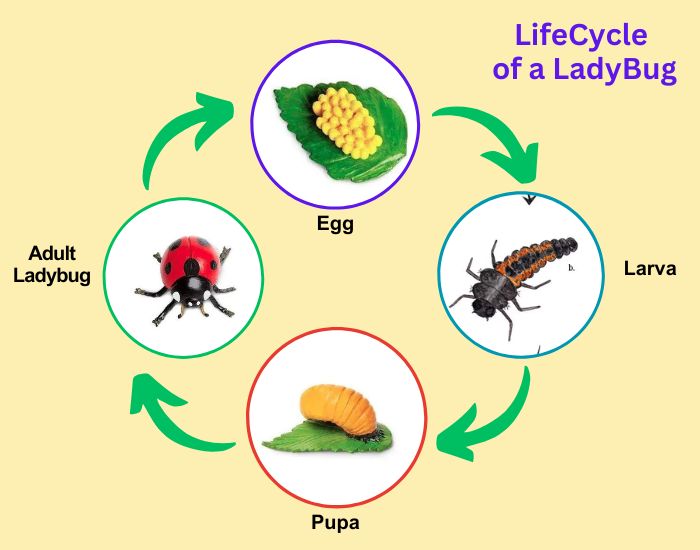
The ladybug, also known as a lady beetle or ladybird beetle, goes through FOUR stages of life. This process is called metamorphosis (it changes and grows at each stage). Many other insects, such as butterflies, moths, and mosquitoes, undergo metamorphosis. There are four stages of ladybug metamorphosis.
4 Stages of Lady Bug LifeCycle
- EGG
- LARVA
- PUPA
- ADULT
Stage 1: EGG 🥚
Did You Know? A ladybug can eat over 5,000 aphids in its lifetime!
Stage 2: LARVA 🐛
- The larva that hatches from the egg is the SECOND stage of the life cycle of the ladybug. The plural for larva is called LARVAE.
- At this stage, the ladybug sheds its hard outer layer, known as the EXOSKELETON. This process of exoskeleton removal is also called MOLTING. In simple words, molting means shedding outgrown skin.
- Ladybug larvae look like tiny alligators. They have elongated bodies and bumpy exoskeletons.
- A larva’s main activity is EATING. They primarily feed on tiny mites, aphids, and other small insects.
- Before going to the third stage of life, larvae increase their body mass by many times their birth size. The step-by-step development of larvae that occurs between molts is called the instar. Ladybug larvae usually molt through four instars before entering the pupa stage.
Stage 3: PUPA 🐚
- The pupa is the THIRD stage of the ladybug life cycle.
- At this stage, the ladybug stops moving and stays attached to a leaf.
- Inside the pupa, its body is changing completely—this process is called metamorphosis.
- After about 7 to 15 days, the pupa turns into an adult ladybug.
Want to learn more about types of metamorphosis, stages, and examples? Check out our metamorphosis for kids.
Stage 4: ADULT🐞
- The adult ladybug is the fourth and final stage of its life cycle.
- The adult ladybug emerges from the pupa with soft, pale wings.
- After a few hours, its colors become bright red or orange with black spots.
- Now it’s ready to explore, eat, and reproduce!
🧠 Quick Summary Chart
| Stage | What Happens |
|---|---|
| Egg | Laid in clusters on leaves |
| Larva | Eats a lot and grows fast |
| Pupa | Transformation stage |
| Adult | Emerges, flies, lays eggs |
What Do Ladybugs Eat?
The most common insects that ladybugs eat are aphids and other soft-bodied insects. Gardeners love them because they eat some of the serious pest of plants
What is the classification of Lady Bug?
Kingdom – Animalia
Phylum – Arthropoda
Class – Insecta
Order – Coleoptera
Family – Coccinellidae
Want to learn how frogs grow too? Check out our Frog Life Cycle for Kids.
Why Do Ladybugs Have Spots?
Ladybugs have spots for several reasons, such as camouflage when they’re in hibernation, warning predators about their bad taste and toxins, communication during their mating season, and thermoregulation. More about lady bug lifecycle.
Frequently Asked Questions
What are the 4 stages of the ladybug life cycle?
Egg → Larva → Pupa → Adult
How long does a ladybug take to grow?
It takes about 4–8 weeks to complete the full cycle.
What do ladybug larvae eat?
They mostly eat aphids and other garden pests.
Why do ladybugs change colors after hatching?
Their exoskeleton hardens and their true colors appear within hours.
Are all ladybugs red with black spots?
No! Some are yellow, orange, or even black with different spot patterns.
🎁 Plant & Animal Science Pack (Grades 2–4)
✅ 8 Printable PDF Pages
✅ Covers Plants, Animals, Life Cycles & Adaptations
✅ Includes Answer Key
✅ Designed for Grades 2–4
Plants Quiz For Kids
Animals Quiz For Kids
Solar System Quiz For Kids
Human Body Quiz For Kids
Physics Quiz For Kids
Chemistry Quiz For Kids
GK Quiz For KIds