
Types of Sharks for Kids
Have you ever wondered how many different types of sharks swim in our vast oceans? From giant filter feeders larger than a school bus to tiny glowing species that fit in your hand, sharks are among the most fascinating creatures on Earth! In this guide, you will explore amazing types of sharks for kids, learn how they hunt and survive, and discover why these awesome fish are essential for healthy marine environments.
Why This Matters
- Ocean Balance: Sharks act as apex predators, keeping ocean ecosystems healthy and balanced.
- Unique Adaptations: Learning about sharks reveals how animals evolve specialized traits for survival.
- Marine Conservation: Understanding shark species helps us protect ocean wildlife for future generations.
What Is a Shark?
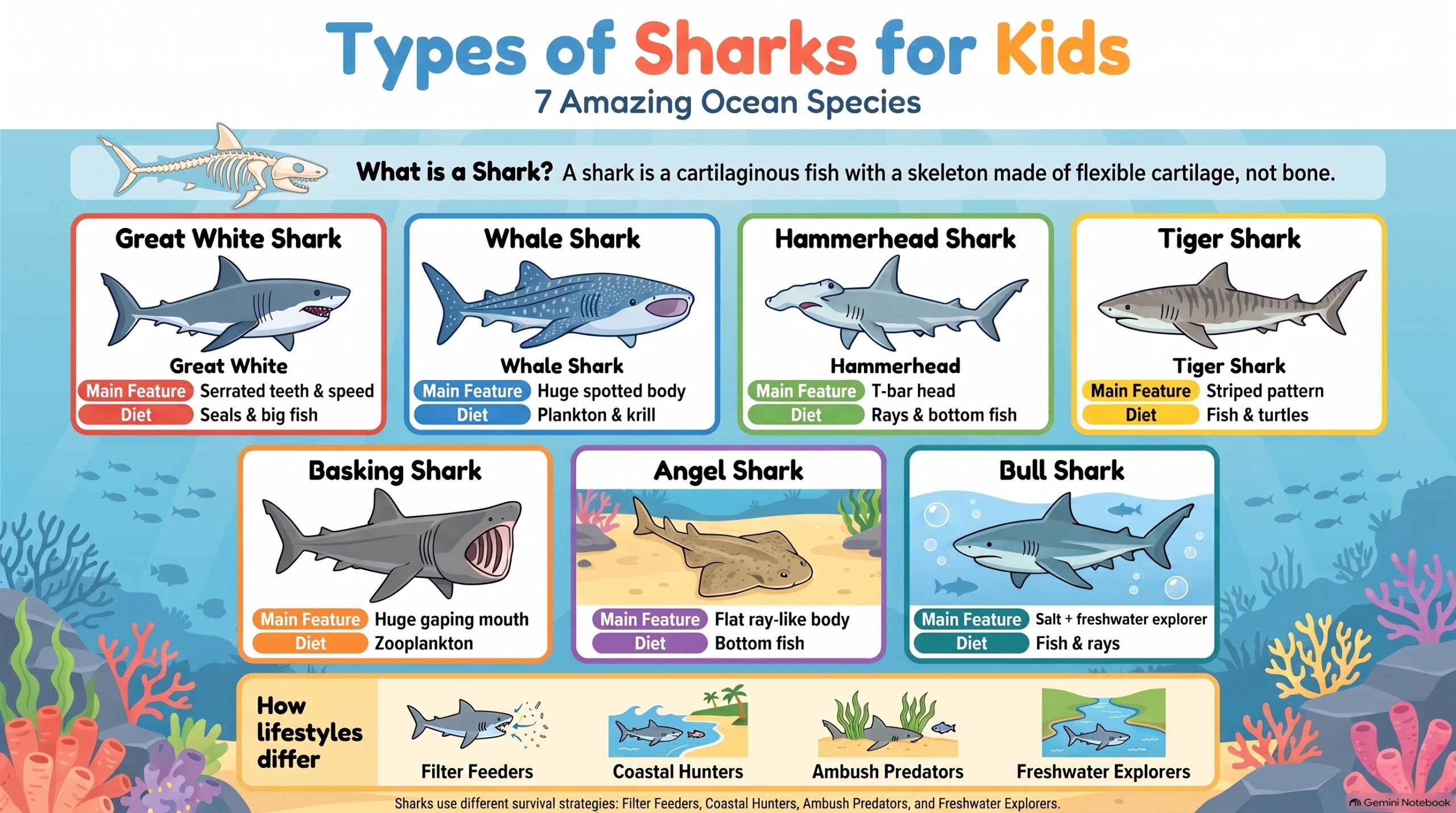
A shark is a special type of fish known as a cartilaginous fish because its skeleton is made of flexible cartilage instead of hard bone. Many bony fish have a swim bladder—a little balloon-like organ inside their body that helps them float without much effort. Sharks usually do not have that balloon. Instead, many species keep swimming so they stay afloat and keep water moving over their gills to breathe. Their skin is covered in tiny, tooth-like scales called dermal denticles, which feel like rough sandpaper and help them glide smoothly through the water like an underwater speedboat. To learn more about fascinating ocean creatures, visit our main animal facts section.
The 7 Main Types of Sharks
There are over 500 known species of sharks alive today! Scientists group them into different orders based on their physical traits, habits, and body shapes. Here is a quick look at seven of the most famous shark species you will meet today:
- Great White Shark
- Whale Shark
- Hammerhead Shark
- Tiger Shark
- Basking Shark
- Angel Shark
- Bull Shark
Quick-Facts Overview
| Category | Fast Fact |
|---|---|
| Habitat | Oceans worldwide, from warm coral reefs to deep cold waters |
| Diet | Carnivores (fish, seals) and Filter Feeders (plankton, krill) |
| Lifespan | 20 to over 100 years depending on the species |
| Size Range | From 8 inches (Dwarf Lanternshark) to 40+ feet (Whale Shark) |
| Class | Chondrichthyes (Cartilaginous Fish) |
Great White Shark
The Great White Shark is the largest predatory fish on the planet and one of the most famous ocean predators.
Great Whites live in cool coastal waters around the globe. They are famous for their powerful jaws packed with up to 300 serrated teeth arranged in multiple rows. When a tooth falls out, a new one moves forward to replace it! These incredible hunters use powerful tails to leap entirely out of the water—a behavior known as breaching.
- Diet: Seals, sea lions, fish, and small whales.
- Special Feature: Highly sensitive snout capable of detecting tiny electrical signals from prey.
- Example Habitat: Coastal waters near South Africa, California, and Australia.
Next, let us look at the ocean’s gentle giant, which feeds in a completely different way.
Whale Shark
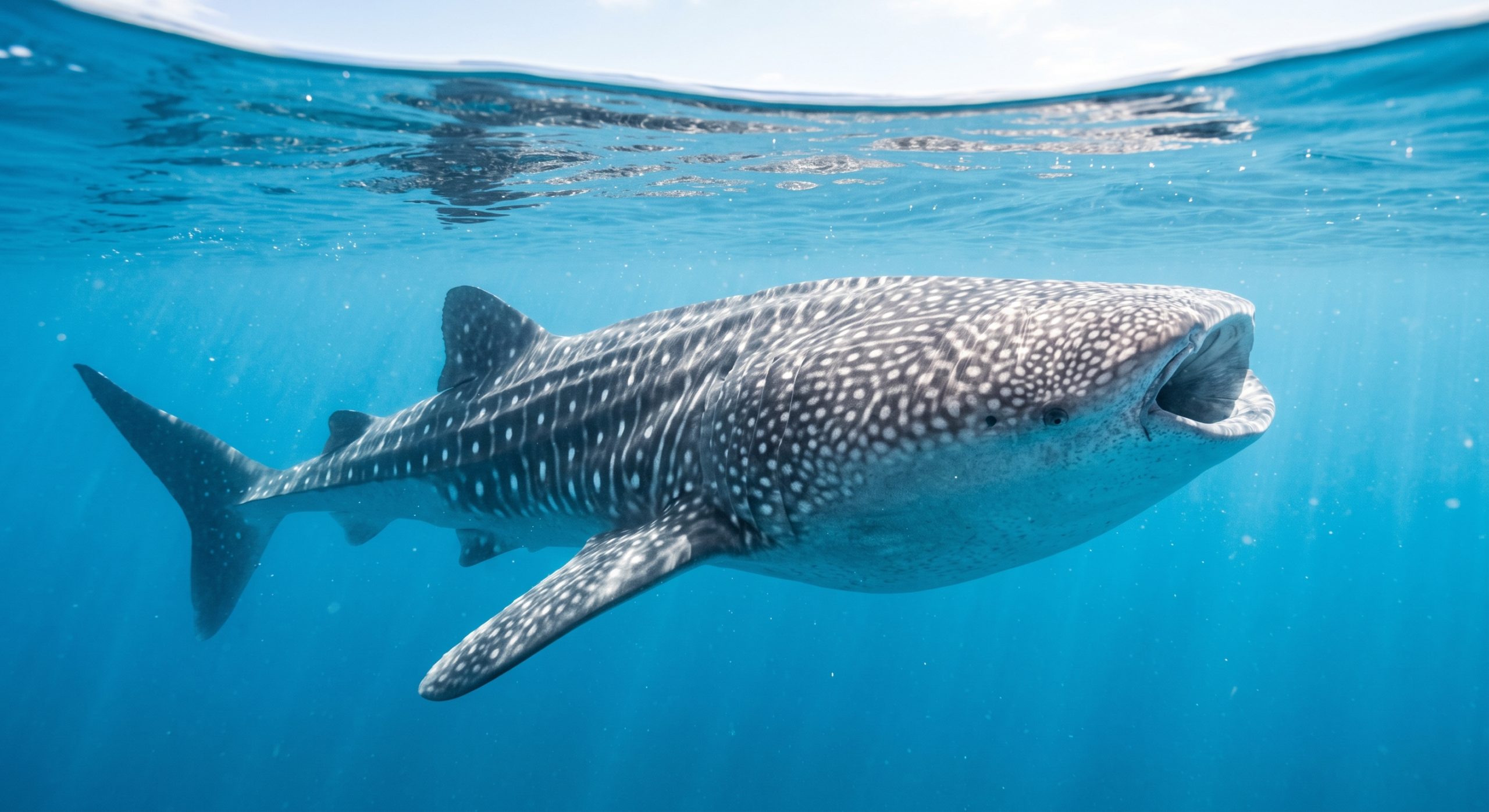
The Whale Shark holds the record as the largest fish in the world, growing up to 40 feet long or more!
Despite its massive size, the Whale Shark is a gentle filter feeder that poses no threat to humans. Instead of hunting large prey, it swims with its huge mouth wide open, filtering thousands of gallons of seawater each hour to collect microscopic food. You can discover more incredible details on our dedicated whale shark facts page.
- Diet: Plankton, krill, small shrimp, and fish eggs.
- Special Feature: Unique pattern of white spots and stripes that acts like a fingerprint.
- Example Habitat: Warm tropical oceans worldwide.
While Whale Sharks filter the water, another shark species uses a uniquely shaped head to scan the sea floor.
Hammerhead Shark
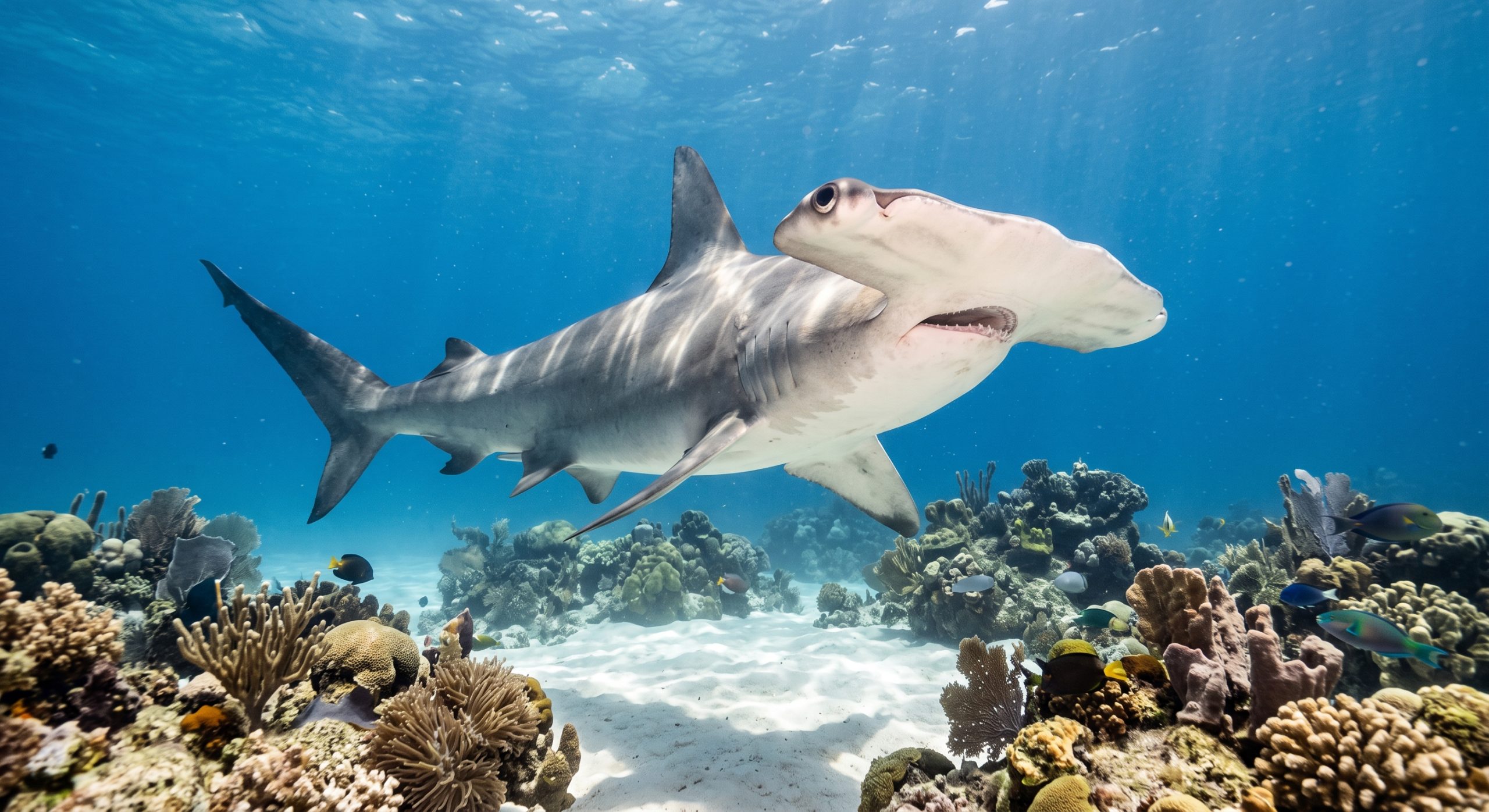
Hammerhead sharks are easily recognized by their uniquely shaped T-bar heads, called cephalofoils.
This flat, wide head gives the hammerhead 360-degree vision and extra surface area for special sensors that detect electrical fields. Hammerheads often swim along the ocean floor, sweeping their heads side-to-side like a metal detector to uncover hidden prey buried in the sand.
- Diet: Stingrays, fish, crabs, and squid.
- Special Feature: Eyes set wide apart allow them to see above and below simultaneously.
- Example Habitat: Warm coastal waters and tropical reefs.
After exploring the unique hammerhead, let us meet a famous predator known for its distinct stripes.
Tiger Shark
The Tiger Shark gets its name from the dark vertical stripes that cover its body when it is young.
Tiger sharks are adaptable, curious hunters found in warm tropical waters. They are often called the ‘garbage cans of the sea’ because they eat almost anything they find, from fish and sea turtles to marine debris. Check out our detailed guide on tiger shark facts to explore their hunting strategy.
- Diet: Fish, turtles, birds, sea snakes, and crustaceans.
- Special Feature: Strong jaws capable of cracking open tough sea turtle shells.
- Example Habitat: Tropical and subtropical coastal areas.
From warm tropical hunters, we move to another colossal filter feeder that prefers cooler waters.
Basking Shark
The Basking Shark is the second-largest living fish on Earth, reaching lengths of up to 33 feet.
Like the whale shark, the basking shark is a peaceful filter feeder. It glides through cool temperate waters with its enormous mouth open wide, using specialized gill rakers to strain plankton from the water. Learn more about this massive plankton-eater on our basking shark facts page.
- Diet: Zooplankton and microscopic marine organisms.
- Special Feature: Massive mouth that can open over 3 feet wide while feeding.
- Example Habitat: Cold and temperate ocean waters worldwide.
Now let us look at a flat shark species that hides perfectly on the ocean floor.
Angel Shark
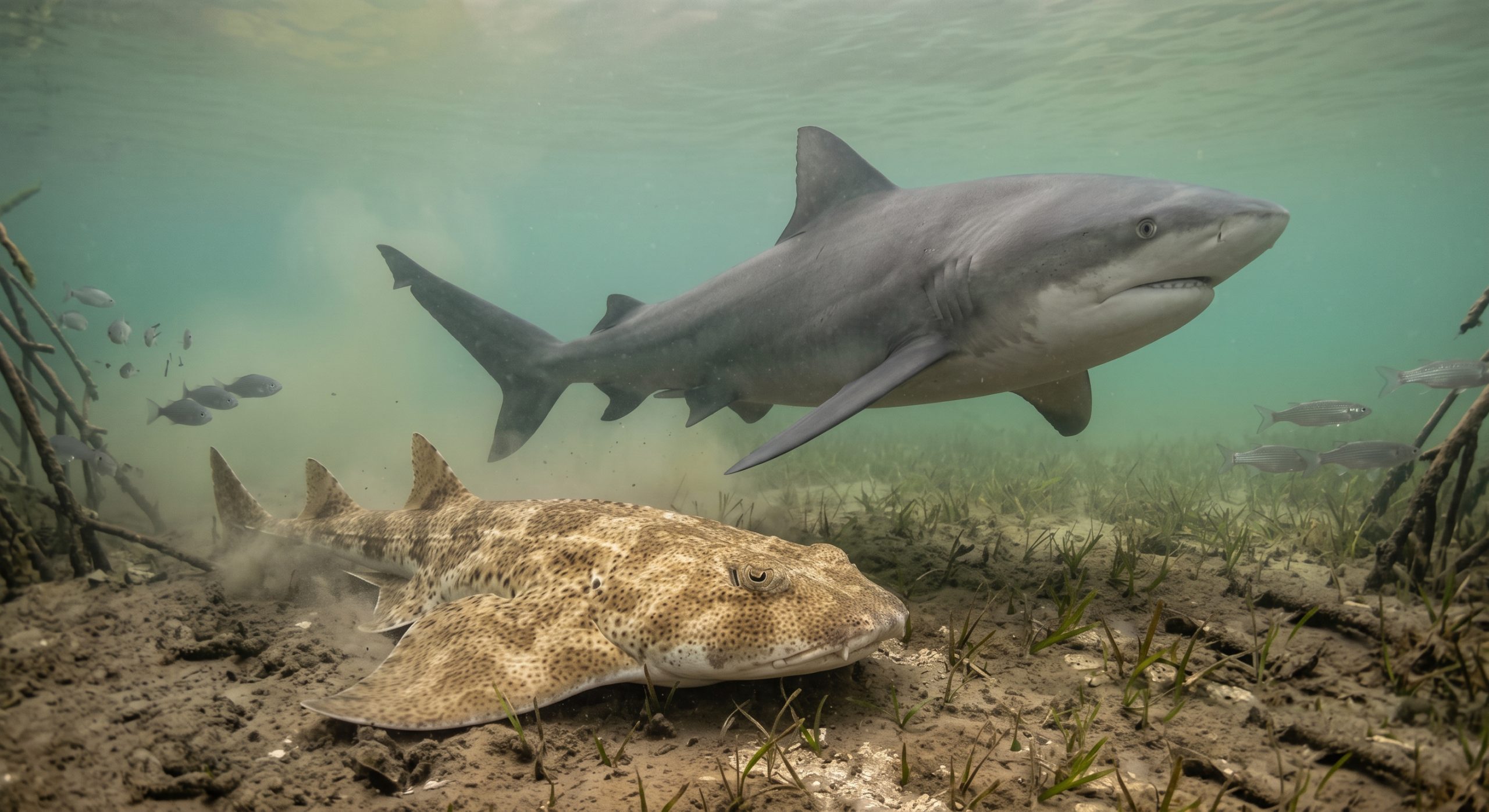
The Angel Shark has a flattened body and broad pectoral fins that make it look very similar to a ray.
Angel sharks are ambush predators that bury themselves in sand or mud on the sea floor, leaving only their eyes exposed. When an unsuspecting fish swims overhead, the angel shark snaps up its prey in a fraction of a second! Discover more about this camouflaged hunter in our angel shark facts article.
- Diet: Bottom-dwelling fish, crustaceans, and squid.
- Special Feature: Excellent camouflage that blends in with sandy ocean sediments.
- Example Habitat: Shallow coastal sea floors and continental shelves.
Finally, let us explore a shark species that can survive in both salt water and fresh water!
Bull Shark
The Bull Shark is a stout, powerful predator famous for its ability to swim in both ocean water and freshwater rivers.
Most sharks cannot survive in fresh water because their bodies lose too much salt. However, bull sharks have special kidneys and glands that balance salt levels, allowing them to swim miles up rivers like the Mississippi and Amazon!
- Diet: Fish, other sharks, rays, and marine mammals.
- Special Feature: Osmoregulation ability to adapt between salt and fresh water.
- Example Habitat: Warm coastal waters, estuaries, and major river systems.
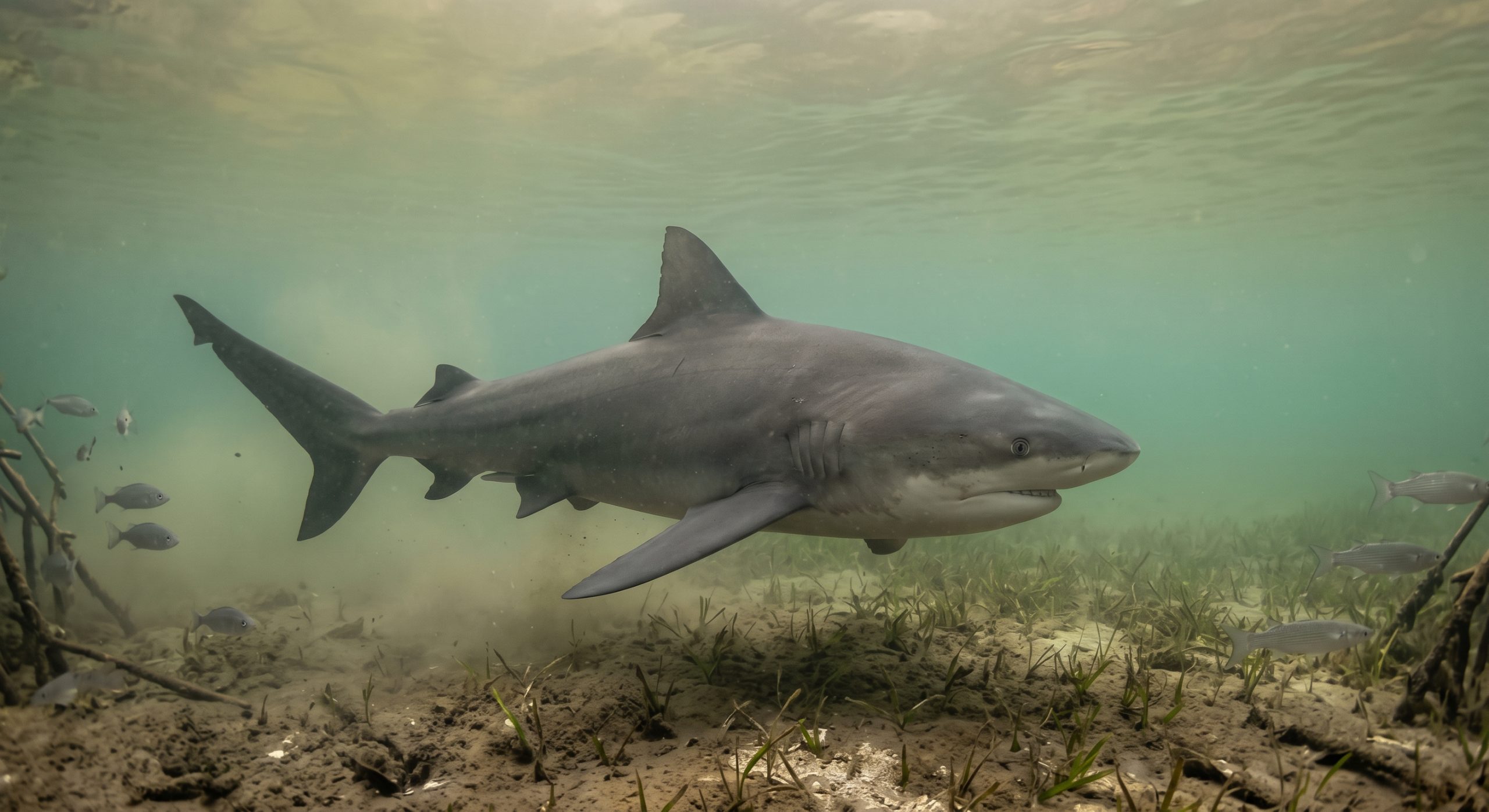
To understand how all these species survive so well, we must examine their incredible physical adaptations.
How Shark Adaptations Work
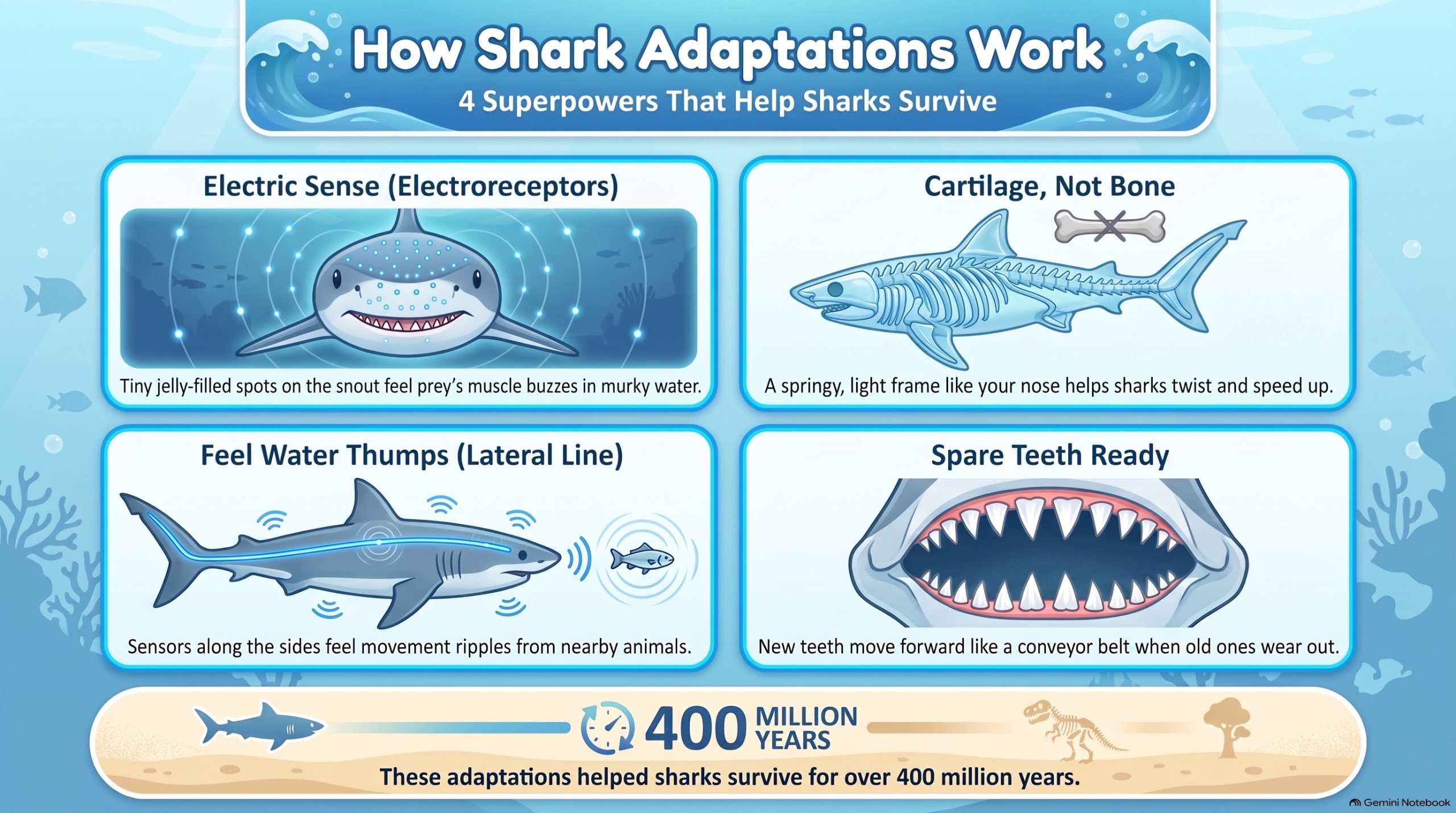
Sharks have survived on Earth for over 400 million years—longer than trees and dinosaurs! Their long-term success comes from remarkable physical traits:
- Electroreceptors (Ampullae of Lorenzini): Imagine having a superpower that can “hear” electricity. Tiny jelly-filled spots on a shark’s snout act like mini antennas. When a fish twitches its muscles nearby, it makes a tiny electric buzz—and the shark can sense it, even in murky water.
- Flexible Cartilage Skeletons: Instead of heavy bone, sharks use cartilage (the same bendy stuff in the tip of your nose). Think of it like a soft, springy frame that helps a shark twist, turn, and speed up without feeling weighed down.
- Lateral Line System: Picture pressing your ear to a wall and feeling music thump through it. Along a shark’s sides runs a special line of sensors that feel water “thumps” and ripples from swimming animals—so the shark can track movement without always seeing it.
- Endless Tooth Replacement: Sharks don’t keep one set of teeth forever. When a tooth wears out or falls out, a new one moves up like a conveyor belt of spare tools—handy for hunters that use their teeth every day.
To learn more about how physical traits help ocean animals thrive, check out our lesson on animal adaptations.
Types of Sharks Vocabulary
| Term | Simple Meaning |
|---|---|
| Cartilage | Flexible, lightweight tissue that makes up a shark’s skeleton instead of bone |
| Dermal Denticles | Tiny tooth-like scales that cover a shark’s skin to reduce water drag |
| Filter Feeder | An animal that eats by straining tiny food (like plankton) from water |
| Ampullae of Lorenzini | Tiny “electric sense” spots on a shark’s snout that feel prey muscle buzzes |
| Breaching | Jumping completely out of the water while hunting or swimming |
| Apex Predator | An animal at the top of the ocean food chain with few natural predators |
| Osmoregulation | The process of balancing water and salt levels inside an animal’s body |
| Cephalofoil | The broad, flattened head structure characteristic of hammerhead sharks |
Summary: Types of Sharks at a Glance
Sharks are incredible cartilaginous fish that inhabit oceans around the world. Whether filter-feeding plankton or hunting fish using specialized senses, every shark plays an important role in ocean health.
How shark lifestyles differ: Sharks are not all the same kind of hunter. Some gently filter tiny food from the water (like the Whale Shark), some chase prey near the coast (like the Great White), some hide and wait on the seafloor (like the Angel Shark), and some can even explore rivers as well as the ocean (like the Bull Shark). That mix of lifestyles is one reason there are so many amazing types of sharks!
Comparison Table
| Shark Type | Main Feature | Typical Diet | Key Adaptation |
|---|---|---|---|
| Great White | Serrated teeth & speed | Seals & big fish | Breaching capability |
| Whale Shark | Huge size & spotted coat | Plankton & krill | Large filter-feeding mouth |
| Hammerhead | Wide T-bar head | Rays & bottom fish | 360-degree vision |
| Tiger Shark | Striped pattern | Fish & turtles | Crushing jaw power |
| Basking Shark | Huge gaping mouth | Zooplankton | Gill raker filtration |
| Angel Shark | Flat ray-like body | Bottom fish | Sand camouflage |
| Bull Shark | Stout body & high tolerance | Fish & rays | Salt/freshwater balance |
Key Takeaway: Protect ocean habitats so these ancient, amazing fish can continue to thrive for millions of years to come!
Amazing Facts
- FACT 1: Sharks have been swimming in Earth’s oceans for over 400 million years—longer than trees and long before the first dinosaurs. That is older than almost every animal group kids learn about in school!
- FACT 2: A shark can lose and regrow up to 30,000 teeth in a lifetime. Imagine going through a whole classroom’s worth of lost teeth… times hundreds!
- FACT 3: The Dwarf Lanternshark is smaller than a human hand, growing to only about 8 inches long—tiny enough to fit in a lunchbox (but it belongs in the deep sea!).
- FACT 4: Whale Shark skin can be up to 4 inches thick—about as thick as a big hardcover book—to help protect these gentle giants.
- FACT 5: Sharks do not have bones; their skeleton is made of light, flexible cartilage, like the soft tip of your nose.
- FACT 6: Some sharks can smell or sense a tiny amount of blood diluted in an Olympic-sized swimming pool—like finding one drop of juice in a huge bathtub.
- FACT 7: The Greenland Shark may live over 400 years. A shark alive today might have been a baby when early European explorers first sailed to North America!
Test Your Knowledge
Test what you learned about different types of sharks with this quick quiz!
Question 1: What makes a shark’s skeleton different from standard bony fish?
- A) It is made of iron
- B) It is made of flexible cartilage
- C) It is made of shell material
- D) It has no skeleton at all
- Correct Answer: B
- Explanation: Sharks are cartilaginous fish, meaning their skeletons are made of light, flexible cartilage rather than hard bone.
Question 2: Which shark species is the largest fish in the entire world?
- A) Great White Shark
- B) Bull Shark
- C) Whale Shark
- D) Tiger Shark
- Correct Answer: C
- Explanation: The Whale Shark is the largest living fish species on Earth, reaching lengths of 40 feet or more.
Question 3: How does a Hammerhead Shark use its uniquely shaped head (cephalofoil)?
- A) To cut through thick ice
- B) To hold extra food
- C) To get 360-degree vision and sense electrical fields
- D) To make loud swimming sounds
- Correct Answer: C
- Explanation: The flattened head gives hammerheads wider vision and extra space for sensors that detect electrical fields of prey.
Question 4: Which shark can comfortably survive in both saltwater oceans and freshwater rivers?
- A) Angel Shark
- B) Bull Shark
- C) Basking Shark
- D) Dwarf Lanternshark
- Correct Answer: B
- Explanation: Bull sharks have unique osmoregulation abilities that allow them to adjust their body chemistry for fresh water.
Question 5: What do Whale Sharks and Basking Sharks eat?
- A) Seals and sea lions
- B) Plankton and tiny marine organisms
- C) Sea turtles and crabs
- D) Large tuna fish
- Correct Answer: B
- Explanation: Both Whale Sharks and Basking Sharks are gentle filter feeders that consume microscopic plankton and small marine life.
Want to try more fun science challenges? Visit our interactive animals quiz page!
Frequently Asked Questions
Are sharks mammals or fish?
Sharks are fish! Specifically, they belong to a class called cartilaginous fish because their skeletons are made of flexible cartilage instead of bone, and they breathe using gills.
What is the smallest shark in the world?
The smallest known shark is the Dwarf Lanternshark. It grows to only about 6 to 8 inches long and can glow in the dark in deep ocean waters!
Do sharks ever sleep?
Sharks do not sleep the same way humans do. While resting, many species keep their eyes open and continue swimming or resting in underwater currents so water keeps flowing over their gills.
How many teeth do sharks have?
Sharks can have between 50 and several hundred active teeth at one time, arranged in multiple rows. Over a lifetime, a single shark can replace thousands of lost teeth.
Why are sharks important to the ocean?
Sharks are top predators that help keep marine ecosystems healthy by eating weak or sick fish, which prevents overpopulation and maintains balance in ocean food webs.
Related Exploring Links
- Learn about individual shark species: Whale Shark Facts, Tiger Shark Facts, Basking Shark Facts, and Angel Shark Facts.
- Explore more animal adaptations: Animal Adaptations Guide.
- Discover general wildlife science: Animal Facts Hub.
Explore more animal facts and try an animals quiz for kids.