
Weird Animal Facts for Kids
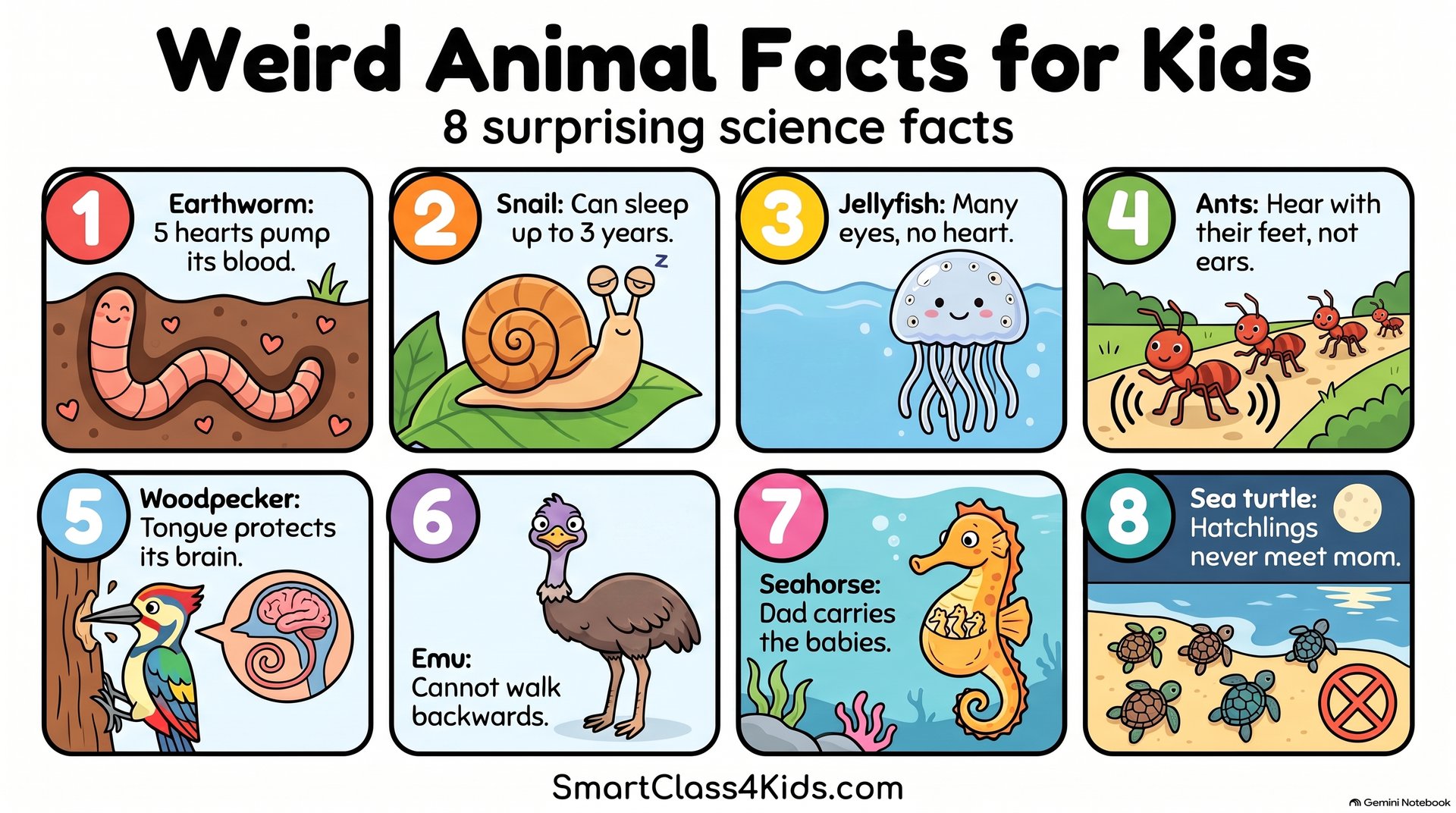
The natural world is full of surprising discoveries that sound like fantasy, but are actually true science. From creatures with extra organs to animals that change their eye colors, nature never runs out of clever tricks. Exploring general animal facts shows us how creative wildlife can be when surviving in the wild.
Here is a quick snapshot of the incredible diversity found across the animal kingdom before we dive into our countdown of strange animal facts for kids!
| Feature | Animal Kingdom Snapshot |
|---|---|
| Habitat mix | Oceans, rainforests, frozen tundra, dark soil, and hot deserts |
| Diet mix | Plant-eaters, hunters, mixed eaters, and leftover-nibblers |
| Lifespan mix | From a few days (mayflies) to over 200 years (bowhead whales) |
| Size mix | From microscopic tardigrades to 100-foot blue whales |
| Class mix | Mammals, birds, reptiles, amphibians, fish, and invertebrates |
12 Surprising Facts About Weird Animals
1. Do earthworms really have five hearts?

You have one heart in the middle of your chest. An earthworm has a whole pump team. Earthworms have five pairs of aortic arches — think of them as five little bicycle pumps wrapped around a smoothie straw (the food tube). Those pumps squeeze together to push blood along while the worm wiggles through dirt.
2. How do ants hear if they do not have ears?

Ants do not have external ears or eardrums on their heads. Instead, ants sense vibrations through special organs on their legs and feel sound waves traveling through the ground. This helps them stay aware of approaching danger and communicate with their nestmates. Meet a giant rainforest ant in our biggest ant guide.
3. Why do only male crickets make chirping sounds?

If you hear a cricket chirping on a warm summer evening, you are listening to a male cricket! Only male crickets chirp by rubbing their textured wings together to create sound patterns. Female crickets use sensitive hearing organs on their front legs to locate the males.
4. Can snails really rest inside their shells for a long time?

Snails do not sleep for years without ever waking like a fairy-tale spell. Still, some snails can seal their shells and rest for many months when the weather turns dry. Mucus forms a protective door so the snail can wait for rain before sliding out again.

5. Why are leeches such strange soft-bodied animals?

Leeches are cousins of earthworms, but their bodies are built for sticky travel. Leeches have suction cups and many body segments that help them cling, stretch, and move. Like worms, they pump blood with a chain of tiny heart-like structures instead of one big heart.
6. Do jellyfish have hearts and brains?

Jellyfish look simple, but they are full of surprises. Jellyfish have no heart and no brain, yet some species can sense light with many eye-like spots. They move by pulsing their bell and catching food with trailing tentacles.
7. What makes emus such unusual birds?
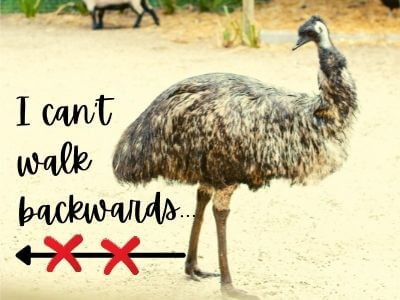
Emus are giant birds that never take to the sky. Emus cannot fly, but they can run very fast on strong legs, and father emus often guard the eggs. Their soft double feathers also help them handle both heat and cold in Australia.
8. Why do chinchillas take dust baths?

Chinchillas have some of densest fur of any land mammal. Water can trap moisture in that thick coat, so chinchillas clean themselves with fine dust baths instead of soapy water. Rolling in dust keeps their fur fluffy and dry.
9. How many hearts does an octopus have?
Picture a swim team with three helpers. An octopus has three hearts that move its blue blood. Two hearts are like water-fillers: they push blood through the gills to pick up oxygen. The third heart is the coach: it sends that oxygen-rich blood out to the arms and body. You can learn even more about these sea creatures by reading amazing octopus facts.
10. Where does a woodpecker fit its super long tongue?
Woodpeckers need long tongues to pull insects out of tiny tree bark crevices. To store this massive feature, a woodpecker’s tongue wraps all the way around its skull inside its head. This amazing structure acts like a built-in safety helmet to protect its brain while pecking hard wood.
11. Can hummingbirds actually fly backwards?
Hummingbirds are true acrobats of the bird world. Hummingbirds can fly backwards, sideways, and even upside down thanks to unique shoulder joints that allow their wings to rotate in a full circle. This maneuverability lets them hover motionless while feeding on flower nectar.
12. Why are flamingos not born pink?
Flamingo chicks hatch with fluffy gray or white feathers! Flamingos turn pink over time from eating food high in natural pigments called carotenoids. Algae and small crustaceans in their diet build up in their feathers, slowly changing their color to bright pink.
Animal Myths vs. Real Science Facts
When reading weird animal facts, it is easy to mix up playground myths with actual science facts. Learning about special animal adaptations helps us understand how animals truly live.
| Common Myth | Real Science Fact |
|---|---|
| Snails sleep for 3 years without stopping. | Fact: Some snails can rest inside a sealed shell for many months to survive dry conditions. |
| The 52 Hz whale is lonely because no whales hear it. | Fact: The 52 Hz whale has a unique pitch, but other whales can likely detect low ocean frequencies. |
| Ostriches bury their heads in the sand when scared. | Fact: Ostriches lay their heads flat on the dirt to hide, which looks like burying from far away. |
| Owls can turn their heads in a complete 360-degree circle. | Fact: Owls can rotate their heads up to 270 degrees thanks to extra neck bones. |
| Touching a toad will give you bumps on your hands. | Fact: Toad skin is naturally bumpy for protection, but it cannot cause human skin bumps. |
| Goldfish only have a 3-second memory span. | Fact: Goldfish can remember information for several months and learn simple patterns. |
Test Your Knowledge Quiz!
Ready to see how much you learned about fun weird animals? Take this mini-quiz or try our complete interactive animals quiz for more challenge!
Question 1
How many hearts does an octopus have?
- A) 1
- B) 2
- C) 3
- D) 5
Correct Answer: C
Explanation: An octopus has three hearts: two push blood through the gills and one pumps blood to the rest of the body.
Question 2
How do ants hear sounds and vibrations?
- A) Through ears on their heads
- B) Through special organs on their legs
- C) Through their antennae tips
- D) They cannot sense sound at all
Correct Answer: B
Explanation: Ants do not have ears; instead, they feel ground vibrations using sensitive organs on their legs.
Question 3
Why do chinchillas take dust baths?
- A) To cool down like a swim
- B) To clean and dry their super-dense fur
- C) To hide from predators underground
- D) To dye their fur a new color
Correct Answer: B
Explanation: Chinchilla fur is so thick that water can stay trapped in it, so they roll in fine dust to stay clean and fluffy.
Question 4
Do jellyfish have hearts?
- A) Yes, one large heart
- B) Yes, three hearts
- C) No, jellyfish have no heart
- D) Only box jellyfish have hearts
Correct Answer: C
Explanation: Jellyfish have no heart and no brain, but some can still sense light with eye-like spots.
Question 5
Why do flamingos turn pink?
- A) From standing in warm sunlight
- B) From pigments in the food they eat
- C) From swimming in mineral lakes
- D) To hide from ocean predators
Correct Answer: B
Explanation: Flamingos are born gray or white and turn pink from carotenoid pigments found in algae and shrimp.
Explore more animal facts and try an animals quiz for kids.