
Geometry Shapes & Formulas for Kids - Example & Free Printable PDF
Geometry Formulas for Kids
Geometry is the part of math that helps us measure the world — how far it is around a soccer field, how much paint covers a wall, or how much water fills a fish tank. We answer questions like these using geometry formulas.
This lesson brings together the most important basic geometry formulas in one place, with simple explanations, real examples, and a quick self-check quiz so you can test yourself. You can also download a free printable geometry formulas chart to keep in your notebook.
What You Will Learn (Lesson Objectives)
By the end of this lesson, you will be able to:
- Identify the basic 2D and 3D shapes used in geometry.
- Understand what perimeter, area, volume, and surface area mean.
- Use the correct formula to solve simple geometry problems.
- Explain where these formulas are used in real life.
This lesson supports Grade 3+ math standards (Common Core CCSS.MATH 3.MD — measurement of area and perimeter — and builds toward later volume and surface-area standards).
Key Words to Know
- Perimeter — the distance all the way around a flat shape.
- Area — the amount of flat space inside a 2D shape (square units like cm²).
- Volume — the amount of space inside a 3D (solid) shape (cubic units like cm³).
- Circumference — the distance around a circle.
- Surface area — the total area of all the outside faces of a 3D shape.
Let’s Start Simple — Perimeter
Perimeter is the easiest place to begin because it’s just adding up the sides.
Imagine walking all the way around the edge of a square playground. If one side is 5 meters, and a square has 4 equal sides, you walk 5 + 5 + 5 + 5 = 20 meters. That total distance is the perimeter.
- Square: Perimeter = 4 × s
- Rectangle: Perimeter = 2 × (l + w)
- Triangle: Perimeter = a + b + c (just add the three sides)
Simple example: A rectangle is 6 cm long and 3 cm wide. Perimeter = 2 × (6 + 3) = 2 × 9 = 18 cm.
Next Step — Area of 2D Shapes
Once perimeter makes sense, area is the next step. Area measures the space inside a shape, so it’s always in square units.
- Square: Area = s²
- Rectangle: Area = l × w
- Triangle: Area = ½ × b × h
- Parallelogram: Area = b × h
- Trapezoid: Area = ½ × (b₁ + b₂) × h
- Rhombus: Area = ½ × d₁ × d₂
Simple example: A rectangle 6 cm by 3 cm → Area = 6 × 3 = 18 cm².
Trickier example: A triangle with base 10 cm and height 4 cm → Area = ½ × 10 × 4 = 20 cm². (The ½ is there because a triangle is half of a rectangle.)
Circle Formulas
A circle has no straight sides, so it uses a special number called pi (π), which is about 3.14.
- Diameter: d = 2 × r
- Circumference: C = 2 × π × r (or π × d)
- Area: A = π × r²
(r = radius, the distance from the center to the edge.)
Simple example: A circle has a radius of 5 cm. Circumference = 2 × 3.14 × 5 = 31.4 cm. Area = 3.14 × 5² = 3.14 × 25 = 78.5 cm².
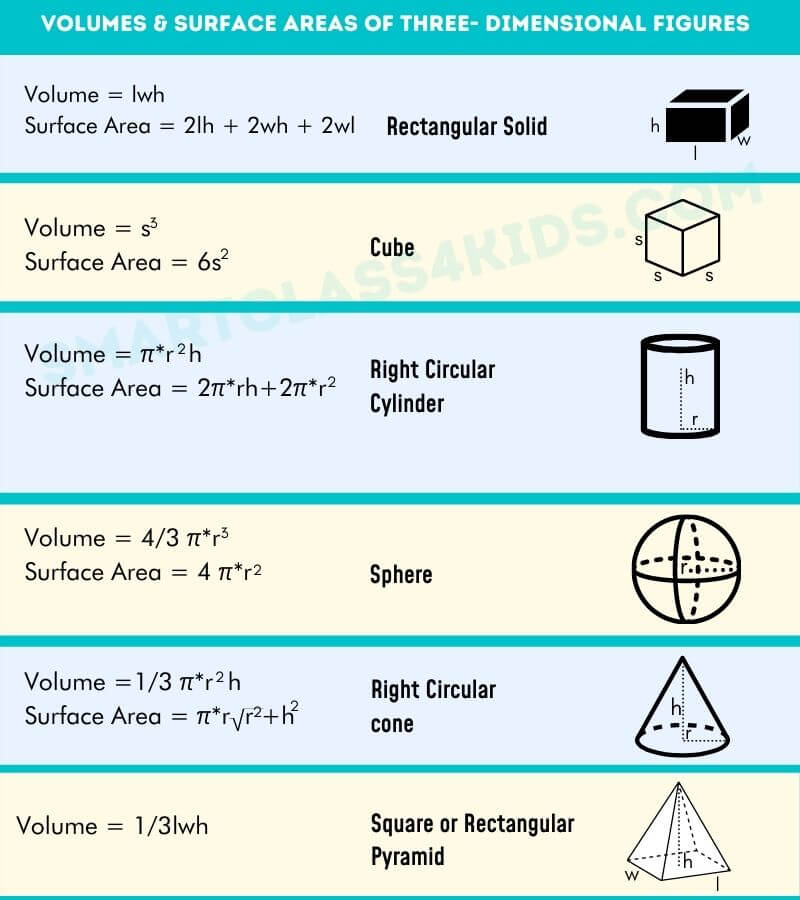
Moving to 3D — Volume
Now we go from flat shapes to solid shapes. Volume measures how much space is inside a solid, so it’s always in cubic units (like cm³).
- Cube: Volume = s³
- Rectangular Prism (box): Volume = l × w × h
- Cylinder: Volume = π × r² × h
- Cone: Volume = ⅓ × π × r² × h
- Sphere (ball): Volume = 4/3 × π × r³
- Pyramid: Volume = ⅓ × base area × h
Simple example: A box 4 cm × 3 cm × 2 cm → Volume = 4 × 3 × 2 = 24 cm³.
Surface Area of 3D Shapes
Surface area is the total area of all the outside faces of a solid — think of how much wrapping paper you’d need to cover a box.
- Cube: SA = 6 × s²
- Rectangular Prism: SA = 2 × (lw + lh + wh)
- Cylinder: SA = 2 × π × r × (r + h)
- Sphere: SA = 4 × π × r²
What Do the Letters Mean?
- s = side • l = length • w = width • h = height
- b = base • r = radius • d = diameter
- π (pi) = about 3.14
- b₁, b₂ = parallel sides (trapezoid) • d₁, d₂ = diagonals
Where We Use Geometry Formulas in Real Life
Geometry isn’t just for school — people use it every day:
- Perimeter: A farmer buying fencing needs the perimeter of the field. You need it to put a border around a poster or garden.
- Area: Buying carpet, tiles, or paint? You need the area of the floor or wall to know how much to buy.
- Volume: Filling a swimming pool, a water tank, or a juice box involves volume.
- Circumference: Bike and car tires, pizza sizes, and running tracks all use circle formulas.
Understanding why a formula matters makes it much easier to remember.
Quick Tips for Success
- Use the same units before calculating (don’t mix cm and m).
- Area → square units (cm², m²). Volume → cubic units (cm³, m³).
- Use π = 3.14 unless told otherwise.
- Draw the shape and label what you know — it helps you pick the right formula.
Try It Out! (Practice Problems)
Work these out on paper, then check the answer key below.
- Two sides of a triangle are 7 cm and 13 cm. The perimeter is 27 cm. Find the third side.
- A square has an area of 49 ft². What is the length of one side? What is the perimeter?
- A rectangle has a width of 4. How long must its length be so the area is 36?
- One angle of a right triangle is 70°. What are the other two angles?
- What is the diameter of a circle with an area of 16π?
- What is the circumference of the circle in problem 5? (Use π = 3.14)
Answer Key (with solutions):
- 7 cm — 27 − (7 + 13) = 7.
- Side = 7 ft, Perimeter = 28 ft — √49 = 7, then 4 × 7 = 28.
- 9 — Area = l × w, so 36 ÷ 4 = 9.
- 20° and 90° — a right triangle has one 90° angle; 180 − 90 − 70 = 20.
- 8 — Area = π r², so r² = 16, r = 4, diameter = 2 × 4 = 8.
- 25.13 — C = π × d = 3.14 × 8 = 25.12 (≈ 25.13).
Get the Free Printable Geometry Formulas Chart
Want every formula on one handy page? Download our free printable geometry formulas chart — great for homework, revision, or pinning above your desk.
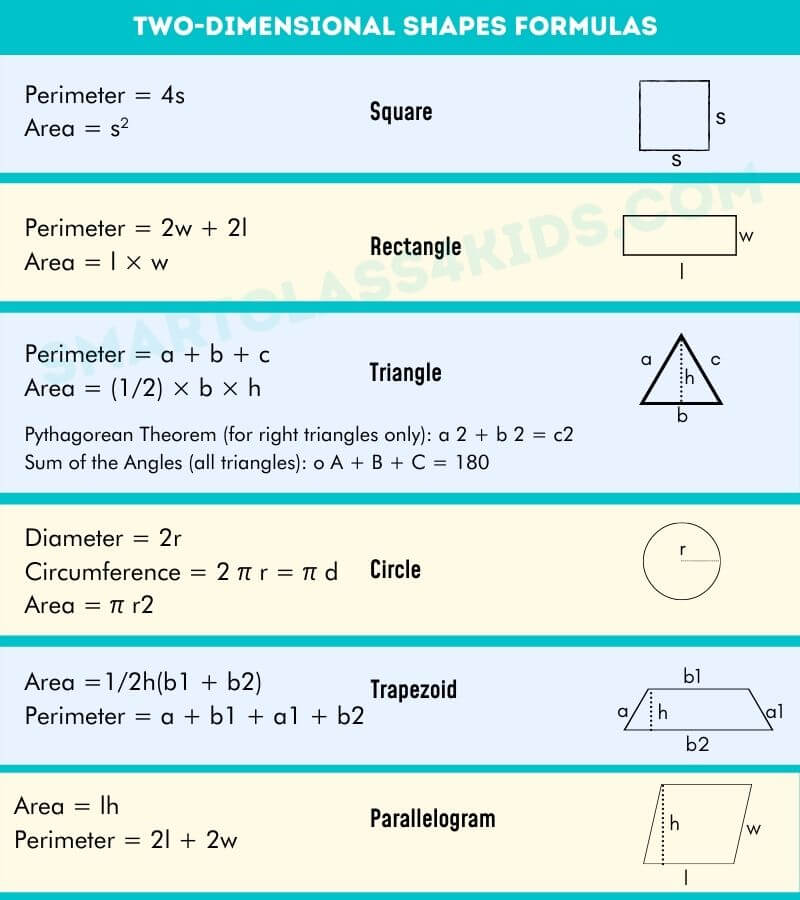
“These are some of the most common geometry formulas to figure out the perimeter, area, volume, surface areas, and circumference for the different shapes, such as square, rectangle, triangle, parallelogram, circle, trapezoid etc.”
- Square
Perimeter = 4s
Area: A = s2 - Rectangle
Perimeter= 2w + 2l
Area= l × w - Triangles
Perimeter = a + b + c
Area = (1/2) × b × h - Circle
Diameter = 2r
Circumference = 2 π r = π d
Area = π r2
- Trapezoid
Area =1/2h(b1 + b2)
Perimeter = a + b1 + c + b2 - Isosceles Trapezoid
Perimeter = 2w + b1 + b2
Area = 1/2h(b1 + b2) - Parallelogram
Area = lh
Perimeter = 2l + 2w
Basic Geometry Formulas
TRY IT OUT
- Two sides of a triangle are 7 and 13 centimeters. The perimeter is 27 centimeters. Find the third side.
- If a square has an area of 49 ft2, what is the length of one of its sides? The perimeter?
- If a rectangle has a width of 4, how long must its length be so that the area is 36?
- If one angle of a right triangle is 70 degree, what are the other 2 angles.
- What is the diameter of a circle with an area of 16 π ?
- What is the circumference of the circle in problem 5? (suggest π = 3.14)
Answer:
1- 7
2- side=7, perimeter=28
3- 9
4- 20
5- 8
6- 25.13